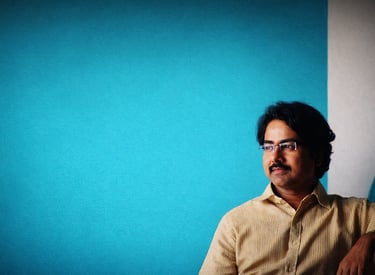








About the Founder
Q1: What brought you to this work?
Not "I was always interested in psychology." That's filler. What specifically happened — in your life, in a relationship, in a moment — that made you realize this was the work you needed to do? The more specific and honest this is, the more trust it builds. Specificity is the opposite of performance.
Q2: What do you believe about healing that most people don't say out loud?
This is your philosophical fingerprint. Something like: "I don't think people come to counseling because they're broken. I think they come because they've been trying to fix everything alone for too long, and they're exhausted." — that kind of statement differentiates you from the 400 other counselors in Hyderabad more than any credential.
Q3: What happened when you started doing this work that changed how you see it?
To answer this let me tell you a true story....
He walked into my cabin the way people do when they've already been given up on — shoulders first, like he was bracing for another door to close.
His name was Hassan. Twenty-two years old. Engineering final year. He hadn't slept properly in months. His professors had complained. His parents had stopped trying. His friends had quietly drifted away. And campus placement season — the one thing that was supposed to make four years of struggle mean something — had rejected him, not once, but every single time.
The university counselor who referred him to me said, simply: “Six months. No progress. I don’t know what else to do.”
I remember wondering, before he arrived, whether I’d be able to help. Whether this was simply a young man who had fallen too far, too fast.
And then he walked in.
— — —
The hair was the first thing you noticed. Tangled, uncombed, almost defiant in its disorder. The clothes looked like they hadn’t been chosen so much as put on in the dark. There was no eye contact in his greeting — just a muttered acknowledgment and a heavy drop into the chair, like his body weighed more than it should.
But when he spoke — when he finally did — I heard something no one else seemed to have noticed.
He was brilliant.
Not just intelligent. The kind of mind that works faster than it can manage — that sees things sharply, says them sharply, and leaves people feeling cut without understanding why. His tone had been misread as arrogance. His directness mistaken for aggression. His unfiltered honesty treated as a character flaw. Nobody had ever told him: your mind is not the problem. The problem is that nobody taught you how to carry it.
His parents had stopped seeing a son and started seeing a failure. “Good for nothing,” they had said. “The cost of your education was wasted.”
I sat with that for a moment. A young man who had been told, by almost every person who was supposed to love him, that he was not enough. And yet here he was — still showing up. Still trying. Still, somewhere underneath all of that debris, hoping.
I have always believed that nature does not play dice. That every person who arrives in front of you carries a reason — whether you can see it yet or not.
I believed that about Hassan.
— — —
I listened to him the way I was taught to listen — not just with my ears, but with everything. I quieted the noise in my own mind, entered a deep meditative stillness, and let his words land without judgment, without agenda.
I have spent decades studying what healing actually looks like — not just talk therapy, but the older, quieter sciences. Water. Sunlight. Energy. Frequency. The understanding that every particle of nature vibrates at a certain resonance, and that when a human being falls out of alignment with their own life force, the symptoms we call “problems” begin to appear. Hassan wasn’t broken. He was out of frequency — disconnected from his own rhythm.
I gave him a set of protocols. Precise, intentional, built around his specific energy and what I sensed was missing in him. Water practices. Morning sunlight. Specific routines to follow without deviation. Some of it was therapeutic. Some of it was ancient. All of it was purposeful.
He listened carefully. He asked almost nothing. And then he left.
He didn’t come back the next day.
Or the day after.
A week passed. The silence felt like an answer I didn’t want.
I told myself: he’s another person who came in looking for a miracle and left when he found work instead. It happens. You can’t hold on to everyone. But I’d be lying if I said I didn’t think about him.
— — —
Nine days later, someone knocked on my cabin door.
The knock itself was different — calm, measured, patient. Not the knock of someone who needs something desperately. The knock of someone who has arrived.
A young man walked in. Neatly dressed. Hair combed, clean. Spine straight. He greeted me with a quiet confidence that took up the exact right amount of space in the room — not too much, not too little.
I looked at him for a full minute before it hit me.
It was Hassan.
I couldn’t help it. I laughed out loud — the kind of laugh that comes when joy catches you off guard. “What happened to you?” I asked.
He smiled. Not a performance of happiness — the real thing. Quiet, earned, unhurried.
“I followed everything,” he said. “Every single thing. Inch by inch. Exactly as you said.”
He told me that on the third day, something shifted. He couldn’t name it exactly. But it felt like something that had been locked inside him for years had started to loosen. He slept differently. He woke differently. He looked in the mirror differently.
And then, quietly, he said the words I will never forget:
“Sir, I trusted you. Because there was only darkness left. And I didn’t know how much longer I could stay in it.”
The room went very still.
I understood what he meant by darkness. He didn’t need to say it more plainly than that.
— — —
A few days later, he returned once more. This time carrying a box.
I hesitated when he set it on the desk. “I can’t accept gifts,” I told him. “You’re not earning yet.”
He looked at me steadily. “Please open it first, sir.”
Inside was a crystal Taj Mahal — glass, delicate, catching the light. Beautiful. Not inexpensive.
I shook my head. He held up a hand before I could speak.
“Sir, two years ago I used to take private tuitions after college. I saved that money myself. It is not one rupee of my parents’. I have never in my life gifted anything to a teacher. Not once. But I want to give this to you. Not as payment. As a memory. So you never forget me.”
I could not say no.
That crystal sits on my desk today.
— — —
Hassan went on to begin his career with L&T. Today, two years later, he works with one of the most progressive companies in Amsterdam. He is, by every measure, a changed man — not because I changed him, but because he decided, in one quiet moment of trust, that he was worth changing for.
We are still in touch.
After Hassan, I couldn’t stop asking myself: how many others are out there like him? How many people are sitting in quiet collapse, being called difficult, being called hopeless, when all they really need is one person to look at them and see what’s still alive underneath?
That question became Discover Persona (my first company for counseling and psychotherapy). Which became UnmuteSelf. Which became this — a platform built not from ambition, but from one afternoon, one young man, and one crystal that still catches the light on my desk every morning.
This work did not begin with a vision. It began with a boy nobody believed in.
I believed in him. And that, it turns out, was enough.